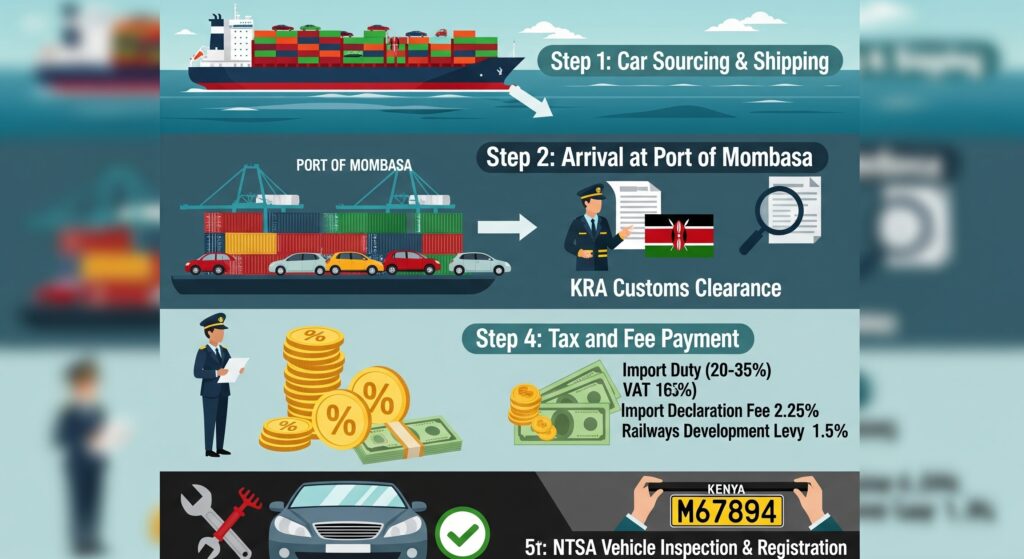
Importing cars to Kenya has proved to be one of the best means through which customers can get hold of various models at affordable rates; however, to make appropriate financial choices, it is essential to understand the import customs duties involved. The article below aims to clarify the process in simpler terms and offers key insights that can facilitate the entire process to ensure that there are no hassles involved.
What You Need to Know About Car Import Duties and Taxes
In the process of importing a car, there are various taxes charged by the Kenya Revenue Authority (KRA). The most significant one is the Import Duty, charged at 35% of the Customs Value (also referred to as CIF Value; Cost, Insurance, and Freight). Additionally, there is the Excise Duty, charged depending on the engine capacity and fuel type. The rates are 20-25% and can be higher depending on the engine capacity. A motor vehicle with an engine capacity below 1500 cc pays 20% duty, while those with engines above 1500 cc are charged 25%.
The Value Added Tax (VAT) is charged at 16% on the cumulative amount of the customs value, duties of importation, and the excise duties payable. Other such charges include the Import Declaration Fee (IDF), normally charged at 3.5% of the CIF valuation, and the Railways Development Levy that attracts 2% CIF.
Calculating Import Duties and Taxes – Working Example
Take the example of importing a Toyota Land Cruiser with a CIF value of Ksh 3,000,000 and engine capacity above 1500cc. The formula would be:
Import Duty (35% of CIF): 1,050,000
Excise Duty (25% of CIF + Import Duty): 25% of Ksh 4,050,000 = Ksh 1,012,500
VAT (16% of CIF + Import Duty + Excise Duty): 16% of Ksh 5,062,500 = Ksh 810,000
Import Declaration Fee (3.5% CIF): KSh 105,000
Railways Development Levy (2% of CIF): Ksh 60,000
Total taxes and fees = approximately KSh 3,037,500, in addition to the CIF price. It is important to note these cumulative costs.
The National Transport and Safety Authority (NTSA) regulates the road user’s compliance with regard to safety and environmental requirements. The key requirements include:
Vehicles must be registered with the NTSA and receive logbooks before use on Kenyan roads.
Imported cars must be tested and approved by authorized bodies such as JEVIC or KEBS.
Usually, cars that exceed eight years since the year of manufacturing are prohibited with some exceptions.
Hybrid cars and electric cars might get some incentives; however, these cars must comply with every safety standard.
Tips to Ensure a Stress-Free Importing Procedure
The KRA uses the Current Retail Selling Price (CRSP) database to check customs values.
Hire reliable clearance and forwarding agents who are conversant with Kenya’s import procedures.
Customs clearance to be made after completing all paper works and inspections. You can browse the imported cars that are available on the website fnlcarmarket.com to get the information you need to make your final decision. Knowledge and planning for all these expenses and requirements will enable consumers to purchase cars and then freely import them to Kenya.
To provide the best experiences, we use technologies like cookies to store and/or access device information. Consenting to these technologies will allow us to process data such as browsing behavior or unique IDs on this site. Not consenting or withdrawing consent, may adversely affect certain features and functions.
Functional
Always active
The technical storage or access is strictly necessary for the legitimate purpose of enabling the use of a specific service explicitly requested by the subscriber or user, or for the sole purpose of carrying out the transmission of a communication over an electronic communications network.
Preferences
The technical storage or access is necessary for the legitimate purpose of storing preferences that are not requested by the subscriber or user.
Statistics
The technical storage or access that is used exclusively for statistical purposes.The technical storage or access that is used exclusively for anonymous statistical purposes. Without a subpoena, voluntary compliance on the part of your Internet Service Provider, or additional records from a third party, information stored or retrieved for this purpose alone cannot usually be used to identify you.
Marketing
The technical storage or access is required to create user profiles to send advertising, or to track the user on a website or across several websites for similar marketing purposes.